Following are my best downhill driving tips to save your brakes when driving down steep grades — including how to use “engine braking” instead of pressing the brake pedal to slow your vehicle down.
We recently returned from a trip to Gatlinburg, Tennessee — home to the Great Smoky Mountains. I had the opportunity to learn some awesome downhill driving tips that made our trip so much more enjoyable.

Many of the roads between tourist traps (I mean “sightseeing destinations”) in the Smoky Mountains are incredibly steep and winding. Some roads wind UP one entire side of a mountain, and then require that you drive back DOWN a narrow winding road on the other side.
Needless to say, with the amount of traffic over the holiday weekend and the sheer number of mountains which exist in the Smokies we had several occasions to test our downhill driving skills (and our brakes!) on this trip.
There must’ve been about a million cars all traveling single file down those narrow mountain roads — all attempting to spot the biggest black bear in the Smokies.
If Your Car Is An Automatic, You Don’t NEED To Downshift, Right?
Wrong!
There are times — even in a vehicle with automatic transmission — that you should manually downshift. Those times are: When you are driving down steep hills.
Sure, I’d seen it done before…
On our family vacations growing up, Dad would drop the old-fashioned dashboard gear shift lever down a notch every time he went down a steep winding hill. Then kick it up a notch at times. Then, back down again.
He played this fancy game of gearshift knobbing virtually every time we drove from Indiana to Florida. (Come to find out, this was usually while traveling through the mountains of Chattanooga, Tennessee.)
Back then, I thought it had more to do with the fact that we were pulling a boat trailer than it did with actually saving our brakes.
Downhill driving tips when towing:
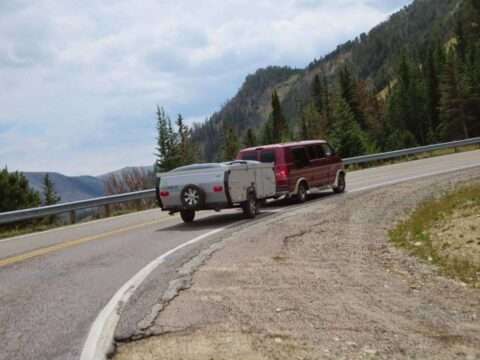
- How To Safely Tow On Steep Downhill Grades
- Parking & Driving Tips When Towing On Hills & Grades
- How To Shift While Towing
Fast-forward some 30 years, and on this trip to the Smoky Mountains I found myself being properly educated about the use of “2” and “1” on my car’s automatic gear shift. (By the way, the following tips apply to all vehicles — not just those pulling trailers.)
Yep, I learned firsthand the proper use of “2” and “1” on my automatic gear shift, and it made our downhill driving experience SO much more enjoyable.
And judging by the rancid smell of hot smoking brakes and brake dust which filled the air throughout most of Gatlinburg, Tennessee this weekend, I know some Smoky Mountain tourists who could learn a thing or two from today’s post, as well!
On A Steep Downhill, Use Engine Braking Instead Of Your Brakes
Instead of using your brakes to slow your vehicle down on a steep grade, use what is known as “engine braking.” (Big-rig drivers use something similar called “jake brake“.)

Trust me, this is one of the best downhill driving tips if you want to:
- Save your brakes a lot of unnecessary wear & tear.
- Actually HAVE brakes at the end of the hill!
In fact, you will increase the life of your brakes by a few months (or even years, depending on how much steep downhill driving you do) if you simply use engine braking whenever possible — rather than actually pressing the brake pedal to slow your vehicle.
In short, you are literally using the engine to break the speed of your vehicle traveling downhill.
Rest assured, this does NO harm to the engine itself or any of the inner working parts.
Here’s how to do engine braking:
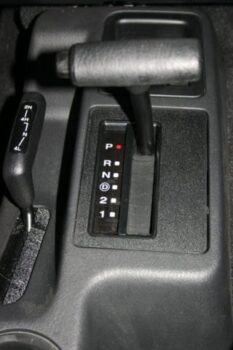
- In a vehicle with automatic transmission, you can “shift on the fly” into 2nd gear (“2” on the gear shift) at any point while you are driving — so long as you are traveling under 50 mph or so.
- You will hear the engine downshift into this lower gear, and the vehicle will begin to slow (naturally and safely) while you continue to drive and maintain your place in the traffic as you head on down the hill.
- The end result: Your need to actually use the brakes will be SIGNIFICANTLY reduced!
Some tips while using engine braking:
- Should you feel the need to slow down even more on a really steep hill, then feel free to “shift on the fly” into 1st gear (“1” on the gear shift) while you’re driving — so long as you are traveling under 30 mph or so.
- In both 2nd and 1st gears, you can continue to give it gas and utilize your brakes like normal — though your need to do so will greatly be reduced.
- Whenever you reach flatter land and no longer need to slow down by pressing the brakes OR using engine braking, then feel free to eventually shift back into your normal “D” (Drive) position on the gear shift. This can be done at any point while you are driving — so long as you are going 50 mph or less (to go from 2nd to “D”) or 30 mph or less (to go from 1st to “D”), as stated above.
About those top speeds in 2nd & 1st gears…
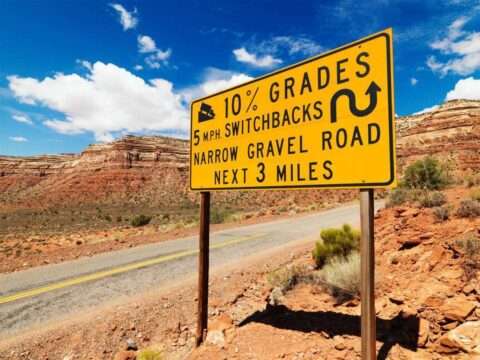
In 2nd gear, you can safely travel at virtually any speed (which the terrain and the degree of incline permit).
If you ever take it down to 1st gear however, you will notice that you can’t go much faster than 35 mph in 1st gear. If you give it gas, the engine will simply rev louder, but you won’t really go any faster. That means you’ve topped out 1st gear, speed-wise.
If you need to go faster when you’re in 1st gear, then simply switch to 2nd gear (yep, “shift on the fly”). You can safely switch between 2nd and 1st gears anywhere in the 30-mph-or-less range.
Once you reach flat land, simply “shift on the fly” back into “D” for normal driving — and use your brakes again for routine slowing and stopping.
Most automatic transmissions allow you to manually select one or more lower gears, such as Low (L), 1st (1) and 2nd (2). In the case of L and 1, the transmission will stay in the lowest gear and not shift on its own. That allows maximum power when you need it, such as on a steep hill, but greatly limits your speed. Some automatic transmissions will shift out of 1st once you reach a certain speed, such as 30 mph, to prevent damage to the transmission or engine, or cut power to the engine. And with others, if you select 2, the transmission starts in 2nd gear and is locked in that gear. This is useful when starting out on slippery surfaces or for engine braking when descending a steep hill.
~ Cars.com
What If You Use The Brakes Instead Of Engine Braking?
Using the brakes on steep downhill grades could result in 1 of 4 hazardous outcomes — so I would advise you to use engine braking instead of your brakes when downhill driving through the mountains.
- Hazardous Outcome #1 – You could significantly wear out your brakes. You could actually reduce the life of your brakes by months or even years, depending on the degree to which you “ride the brake” on such steep grades.
- Hazardous Outcome #2 – You could lose your brakes altogether! No joke. That stench of brake dust (that goes hand-in-hand with squealing brakes) is a sign that your brakes are too hot. If you overheat your brakes and don’t take enough time in between to let them cool off a bit, then you can actually fry your brakes — leaving you with virtually NO stopping power at the bottom of the hill. You may even begin to see smoke coming from your overheated brakes. Everyone knows, where there’s smoke there’s fire — so you’re really taking your chances at this point. Avoid smoking brakes downhill at all cost.
- Hazardous Outcome #3 – You’re polluting the ozone. And in a place like beautiful Gatlinburg, Tennessee with of all kinds of natural beauty… why would you want to do that? You think I’m kidding about the smell of brake dust? I’m not! I actually wonder how those working in the souvenir shops and stores which are perched on the downhill side of the main roads can even handle the stench.
- Hazardous Outcome #4 – You run the risk of being humiliated via photographs and video footage showing you — behind the wheel — driving like an imbecile with hot, smoking brakes down a steep hill. (If we are stuck behind you, that is. And that’s a price you don’t wanna pay, trust me!)